Let AI Be the Servant, Not the Master
Artificial Intelligence is reshaping education at a remarkable pace. New tools appear almost weekly, each promising to personalise learning, automate routine tasks or improve student outcomes. It is easy to become captivated by what these technologies can do. Yet, in focusing on their capabilities, we risk overlooking a more fundamental question: what should remain uniquely human?
During the past several years, my research has explored the role of Artificial Intelligence in mathematics education, particularly its ability to support teachers through formative assessment and feedback. The technology is impressive. It can analyse large numbers of student responses, identify patterns that might otherwise go unnoticed and provide tailored suggestions within seconds. Properly used, AI has the potential to become one of the most valuable tools education has ever known.
The debate, however, should never be about whether Artificial Intelligence is powerful. That question has largely been answered. The more important question is whether we are clear about the purpose of education itself. Before deciding what AI should do, we must first decide what education is meant to achieve.
For generations, education has often been viewed as the transmission of knowledge from teacher to student. If that were its sole purpose, technology would already have solved much of the problem. Information has never been more accessible than it is today. A student with an internet connection can reach more knowledge in minutes than previous generations could access in years.
Yet schools have never existed simply to distribute information.
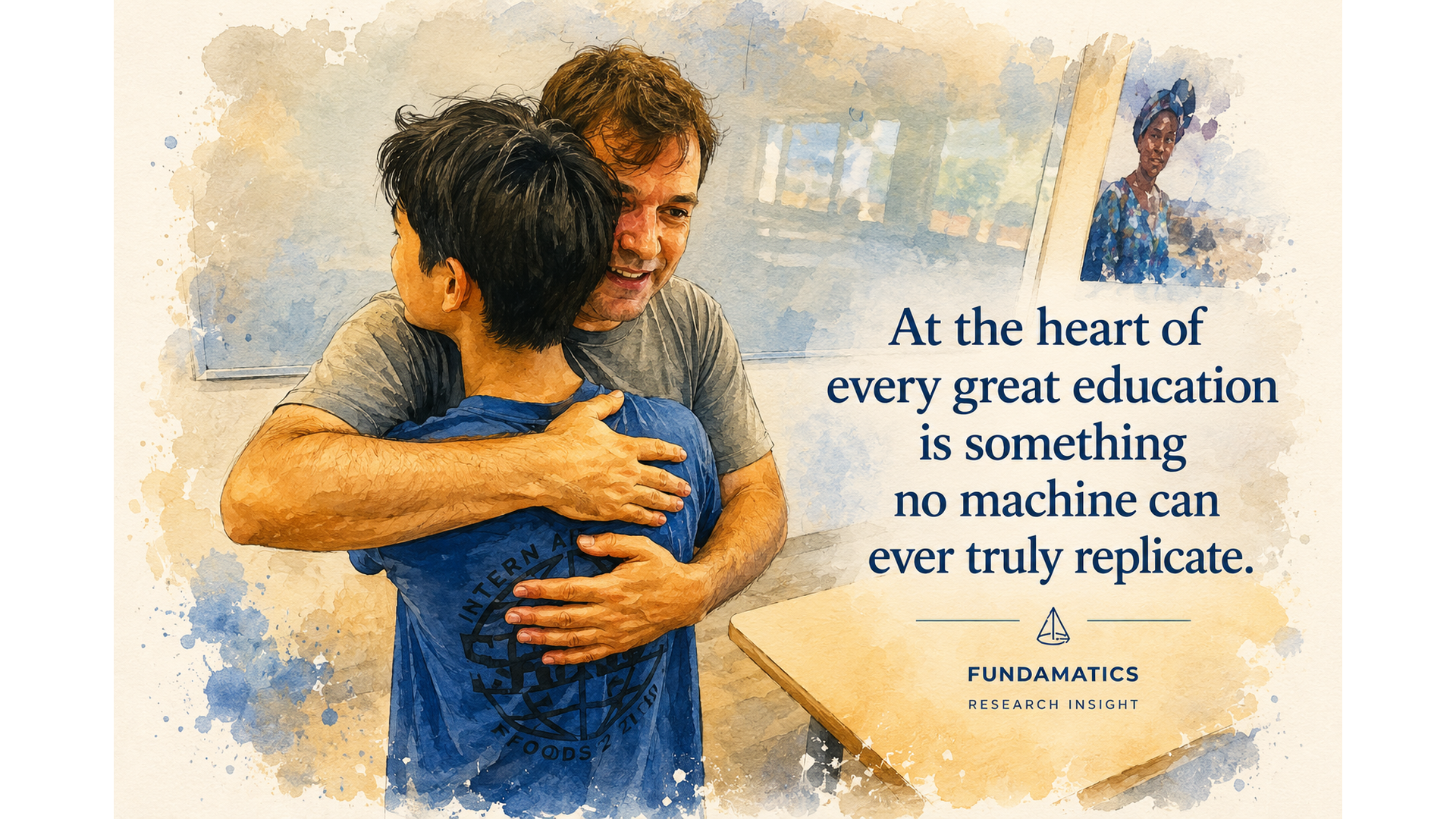
The teachers who leave the deepest mark on our lives rarely do so because they explained a concept more clearly than anyone else. They are remembered because they recognised potential that students could not yet see in themselves. They encouraged persistence after failure, challenged assumptions, built confidence and created environments in which curiosity could flourish. Those qualities cannot be reduced to data points or algorithms because they depend on empathy, professional judgement and human relationships.
This is precisely where Artificial Intelligence should find its place. AI is exceptionally good at processing information, identifying patterns, generating examples and automating repetitive tasks. These are strengths that should be embraced rather than feared. Every hour a teacher no longer spends preparing routine worksheets or analysing repetitive assessment data is an hour that can instead be invested in conversations with students, thoughtful feedback and the countless small interactions that shape a learner's confidence.
History offers many examples of technologies that transformed professions without replacing the professionals themselves. Calculators changed mathematics but did not eliminate mathematicians. Medical imaging transformed healthcare but did not replace doctors. GPS revolutionised navigation but did not make experienced pilots unnecessary. In each case, technology became most valuable when it enhanced human expertise rather than attempting to substitute for it.
Education should be no different.
The future of education should not be measured by how many decisions we can delegate to Artificial Intelligence. It should be measured by how effectively technology enables teachers to focus on the uniquely human aspects of learning: recognising potential, inspiring curiosity, exercising judgement and building relationships that encourage students to believe they are capable of more than they imagined.
That distinction matters because the purpose of education has never been technological. Its purpose has always been human. Technology should therefore adapt to education—not the other way around.
As Artificial Intelligence becomes increasingly capable, educators face an important responsibility. We must decide not only what machines can do, but also what they should never be asked to do. Some responsibilities belong uniquely to people because they require wisdom, compassion, trust and belief in another human being. Those qualities are not obstacles to innovation; they are the very reason innovation matters.
The future of education will undoubtedly include Artificial Intelligence. I welcome that future. But I hope we build it around a simple principle that remains true regardless of how advanced technology becomes:
Technology should serve learning. Learning should never serve technology.
When we remember that principle, Artificial Intelligence becomes what it was always meant to be: not the master of education, but one of its most powerful servants.