A few years ago, my nephew asked me a simple question: how can subtracting a negative number result in a positive one?
It is the kind of question that can easily be answered with a rule. We can tell students that subtracting a negative is equivalent to adding a positive, give them a few examples, and move on.
But knowing a rule is not always the same as understanding it.
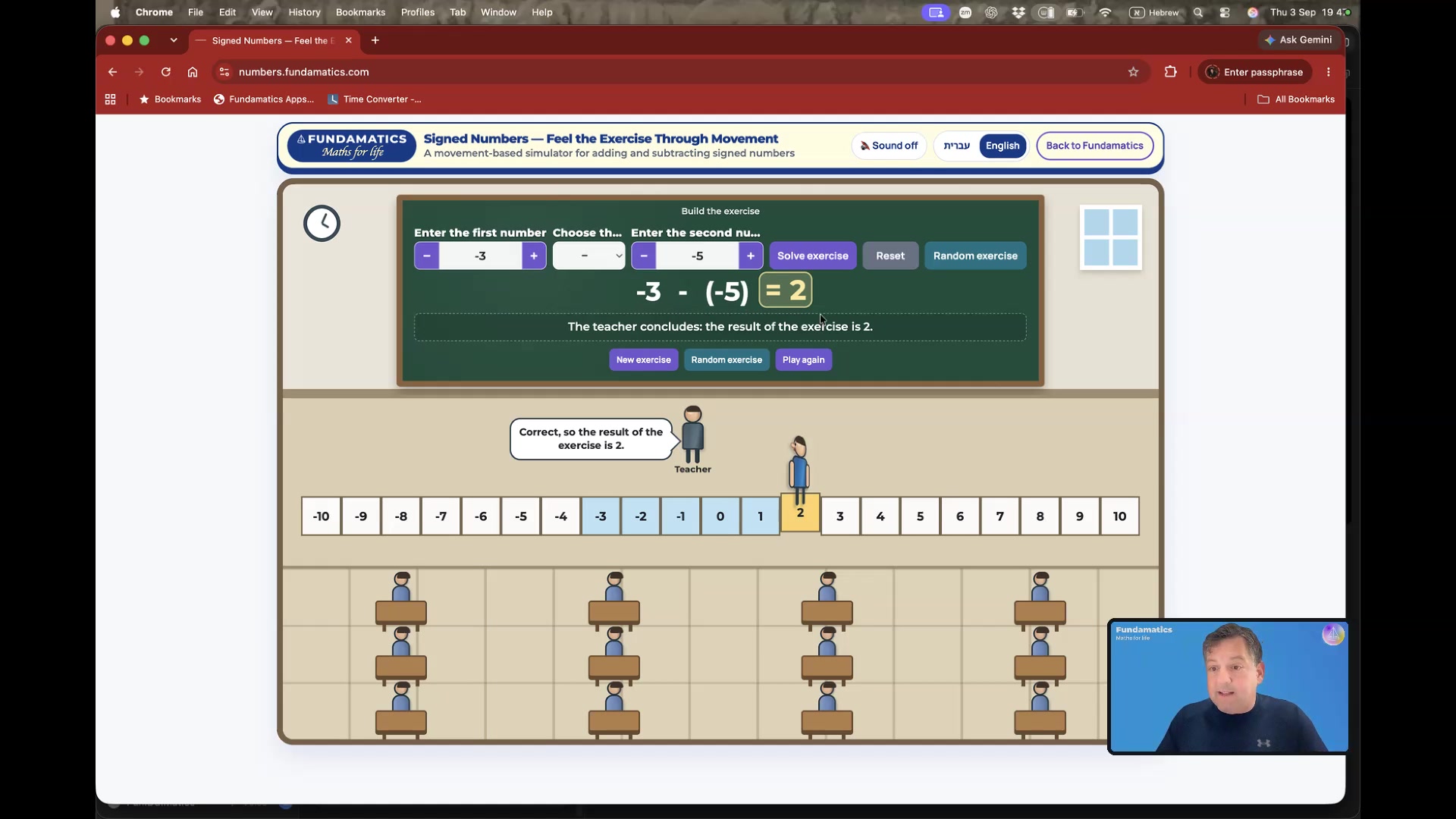
So instead of explaining the rule again, I tried something different. We imagined numbers written on tiles across the floor. The first number told him where to stand. The operation determined which direction to face. The second number determined how to move.
Addition and subtraction were no longer only symbols on a page. They became direction and movement.
When we reached an expression such as negative three minus negative five, he stood at negative three, turned according to the operation, and moved according to the second number. The result was not something I needed to announce. He arrived at it.
That small activity stayed with me.
Years later, we recreated the idea as an interactive Fundamatics app. Students can experiment with different signed-number operations, follow the movement step by step, and explore the relationships for themselves.
There is a broader teaching idea here.
Sometimes our first instinct is to make an explanation clearer. But another possibility is to change the experience entirely.
A mathematical idea that seems abstract on the page can sometimes become much more accessible when learners can see it, move through it, test it and discover the result themselves.
Perhaps the question is not only, "How can I explain this better?"
Sometimes the more interesting question is:
"How can I help students experience it?"