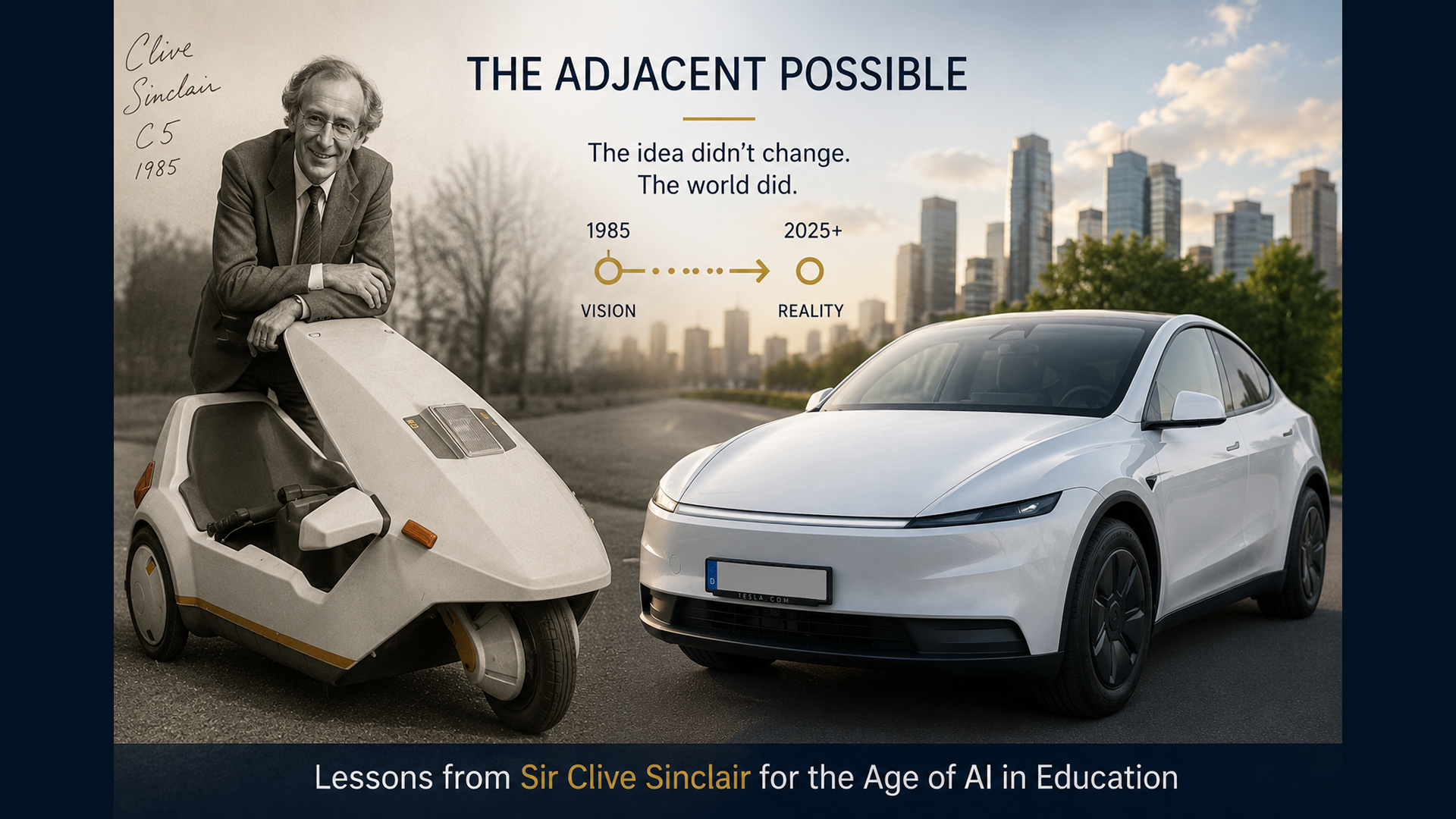
The Adjacent Possible: What Sir Clive Sinclair Can Teach Us About AI in Education
Research Insight
A Great Idea at the Wrong Time
When we think about innovation, we often assume that better technology naturally leads to better outcomes.
History tells a different story.
In 1985, Sir Clive Sinclair, one of Britain's most celebrated inventors and the creator of the ZX Spectrum computer, introduced the Sinclair C5, a compact electric vehicle that he believed would transform urban transportation. Looking back today, the idea seems remarkably familiar. An affordable electric vehicle for short city journeys is no longer revolutionary. It is becoming commonplace.
Yet the Sinclair C5 became one of history's most famous commercial failures.
The idea wasn't wrong.
The timing was.
Battery technology was limited. Charging infrastructure did not exist. Cities were designed around conventional vehicles, environmental concerns had not yet become a mainstream priority, and consumers simply were not ready to change the way they travelled.
Why Tesla Succeeded
Now consider Tesla.
Was Tesla successful simply because it built a better electric car?
I don't think so.
Tesla entered a completely different world. Battery technology had matured, charging networks had expanded, governments had begun encouraging cleaner transportation, and public awareness of climate change had fundamentally shifted consumer attitudes. Tesla did not create these changes. It recognized that they had finally converged.
The Missing Ingredient
Innovation researcher Steven Johnson describes this phenomenon as the Adjacent Possible. The most successful innovations rarely succeed because they leap far into the future. They succeed because multiple technological, economic, and social conditions mature together, making the next step possible.
Innovation is therefore not only about inventing something new.
It is about recognizing when the world is finally ready for it.
What This Means for AI
This idea has stayed with me throughout my research on Artificial Intelligence in mathematics education.
Today, AI is advancing at an extraordinary pace. Schools, governments, and technology companies are all racing to integrate it into education. The opportunities are undeniable. But the lesson from Sinclair reminds us that successful innovation is never determined by technology alone.
The question is not whether AI is ready.
In many ways, it already is.
The more important question is whether our educational ecosystem is ready.
Are teachers equipped to work confidently alongside AI? Have assessment methods evolved to reflect an AI-enabled world? Do schools have the necessary infrastructure? Have we established ethical principles that ensure AI strengthens learning rather than simply automating existing practices?
Without these adjacent conditions, introducing AI too quickly risks repeating Sinclair's mistake. We may end up implementing extraordinary technology into a system that has not yet evolved to support it.
The Teacher's Place in an AI World
One of the central conclusions of my research is that AI should strengthen the work of educators, not replace it.
Teachers remain indispensable in defining learning goals, designing meaningful mathematical experiences, interpreting student thinking, evaluating AI-generated materials, and exercising the professional judgment that no algorithm can replicate.
AI can dramatically improve efficiency and expand possibilities, but educational purpose, pedagogy, and human judgment must remain firmly in human hands.
The Real Lesson
The lesson from Sir Clive Sinclair is therefore not to fear innovation, nor to slow it down.
It is to recognize that lasting innovation succeeds when technology evolves together with people, institutions, and society.
Perhaps the future of AI in education will not be determined by how intelligent AI becomes.
It will be determined by how wisely we prepare the ecosystem around it.
Only then can AI become what it was always meant to be: