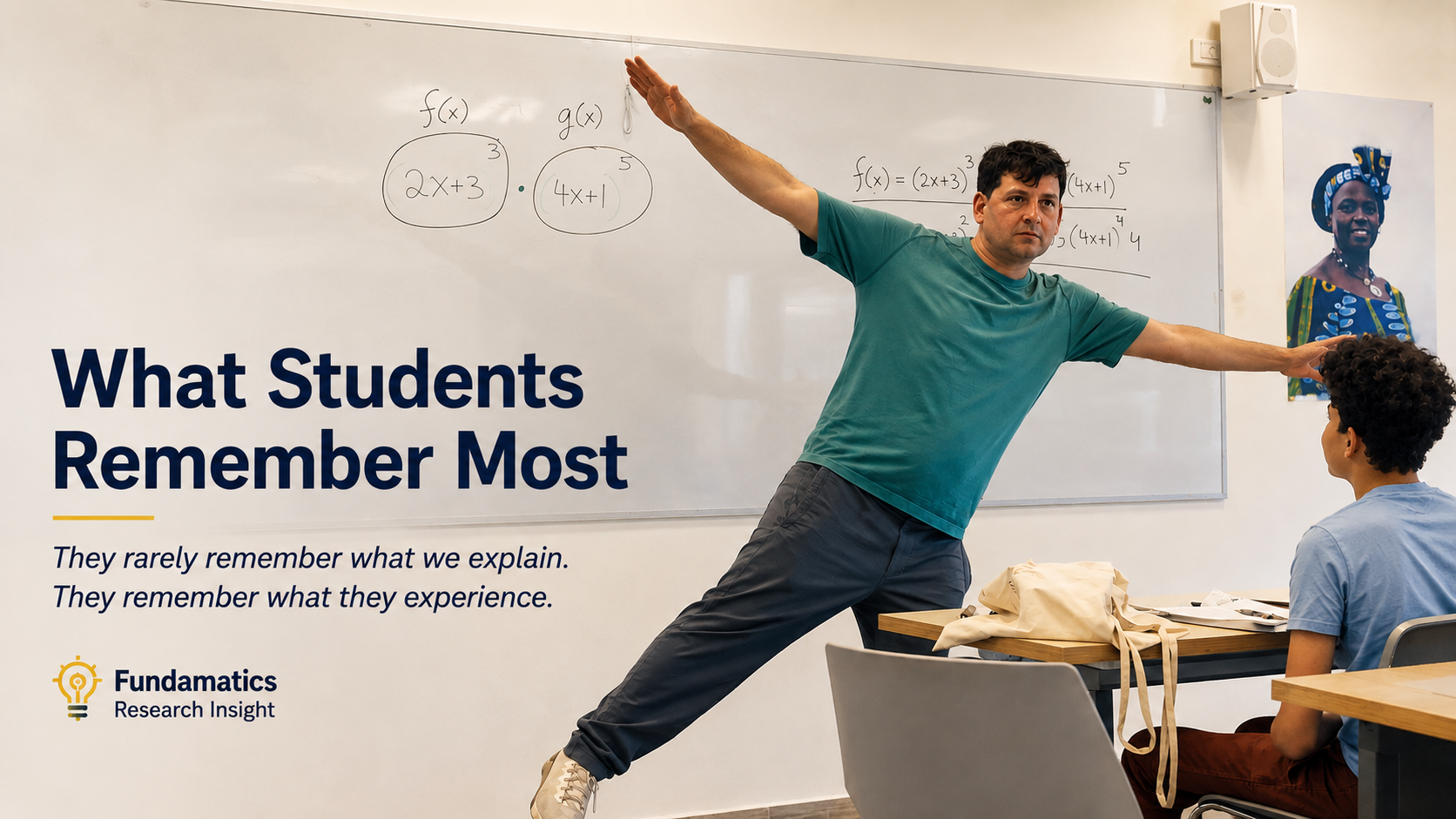
What Students Remember Most
Research Insight
Several years ago, I introduced signed numbers to a class in a way that felt completely unfamiliar to many of the students. Rather than beginning with rules, formulas or symbolic notation, I presented a simple challenge. A character stood on a number line, facing either forwards or backwards. It could move a given number of steps, turn around or continue in the direction it was already facing. Before long, students were making predictions, testing ideas and debating what would happen next.
Only later did we introduce the mathematical notation. By that stage, the symbols no longer felt abstract because they described an experience the students had already lived through rather than a rule they were expected to memorise. That lesson has stayed with me ever since, not because it was a particularly sophisticated activity, but because it reminded me of something fundamental about education.
Students rarely remember what we explain. They remember what they experience.
Today, this distinction has become more important than ever. Students can watch videos, explore interactive simulations or ask Artificial Intelligence to explain almost any concept within seconds. Access to information is no longer the challenge it once was, and explanations are no longer the exclusive role of the classroom.
If teaching were primarily about delivering information, technology would already have solved much of education. Instead, it has revealed something that great teachers have always known: explanation is only the beginning.
The teachers we remember are rarely those who simply explained a topic well. They are the ones who challenged us to think differently, encouraged us when we struggled and created learning experiences that made ideas meaningful. They transformed information into understanding and curiosity into confidence.
Artificial Intelligence is exceptionally good at generating explanations, creating examples and answering questions. These capabilities should be welcomed because they allow teachers to spend less time on routine tasks and more time doing what matters most: designing experiences that invite students to explore, question, struggle and discover.
Perhaps this is the unexpected gift that Artificial Intelligence offers education. By becoming increasingly capable of explaining, it forces us to recognise where the true value of teachers has always resided. Their greatest contribution has never been the delivery of information, but the creation of the conditions in which meaningful learning can take place.
As technology continues to evolve, schools should certainly embrace the opportunities it creates. At the same time, we should resist confusing access to information with education itself. Information can expand knowledge, but experiences shape understanding, confidence and curiosity in ways that explanations alone never can.
Years from now, students are unlikely to remember every explanation they heard in school. They will remember the lesson that suddenly made an idea click, the teacher who believed in them before they believed in themselves and the experience that changed the way they thought.
Great teaching has never been defined by the information it delivers. It has always been defined by its ability to bring ideas to life.