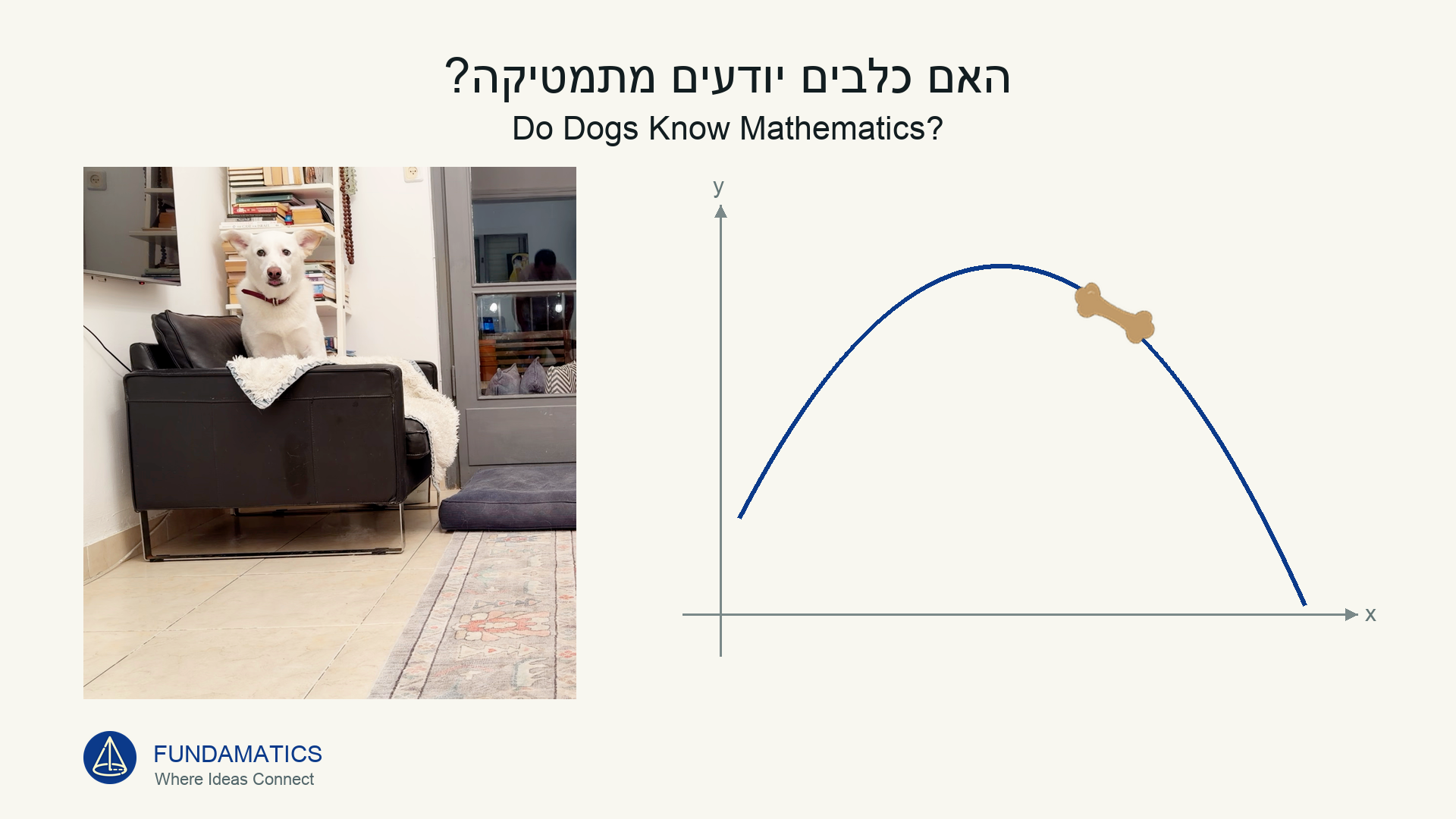
This is Ruby. When I throw her a treat, she follows it through the air, moves and finds a place to catch it. It is an ordinary moment between a person and a dog. But watching her makes me think about something I believe very strongly as a teacher.
The treat follows a trajectory that mathematics can describe. In a simplified model, with gravity acting and air resistance ignored, that trajectory is a parabola. The curve in the opening of the film illustrates the idea. It is not a measured reconstruction of this particular throw. Ruby, meanwhile, is interested in the treat.
The full film: Hebrew audio with English subtitles. 1:52.
Read the film transcriptRuby does not know the formal language of parabolas. She is not writing a quadratic function or working through a mathematical calculation. What we can see is her responding to a moving object. A successful catch does not tell us exactly how she does it, and the film does not prove a particular cognitive mechanism. That small distinction is what makes the moment interesting.
We can describe a relationship mathematically without assuming that someone experiencing it is using the same description. Movement, distance and direction are part of the situation before we draw axes or write symbols. Formal mathematics gives us a way to describe those relationships more precisely, examine our assumptions and explore what changes from one situation to another.
That brings me back to learners. A child may estimate a distance, notice a repeating pattern or compare quantities long before being able to express those relationships formally. This does not mean the child already understands every mathematical concept involved. It does mean there may be an experience worth listening to, a starting point for a conversation rather than an empty space waiting for an explanation.
Good teaching can help make the connection. We can ask what a learner notices, invite a drawing, compare examples and gradually introduce language and representations that make the idea clearer. Intuition can be mistaken, and formal reasoning remains essential. The aim is to help experience and mathematical language inform one another, not to let one replace the other.
Ruby is not a demonstration of mathematical understanding. She is a warm reminder to look more carefully at the relationships already present in everyday experience. When I say there is mathematics in everyone, I mean it as a commitment to seek those possibilities and help them grow. Sometimes, we just need to know how to bring it out.