Before correcting a student’s answer, it can help to understand what the student is actually seeing.
In this film, I introduce LEAD through a personal story from a mathematics lesson. The focus is Listen: attending to the learner’s words, work and interpretation before rushing to explain.
Watch the English film on the Fundamatics YouTube channel. English and Arabic subtitles are available through CC on YouTube.
“I can see it is not a right angle”
A student could readily recognize some right angles in a box. But when a diagonal was drawn across a face, the angle between that diagonal and an edge no longer looked like 90 degrees to her.
Her explanation revealed something worth listening to: the relationship between the two-dimensional drawing on the page and the three-dimensional object she was trying to imagine.
Listening helped me understand what needed a response. Instead of repeating that the angle was a right angle, I looked for an experience she could connect with: an umbrella.
A familiar object, a different way of seeing
In the analogy, AB represents the umbrella’s stick, and the plane AA′D′D represents an idealized flat canopy containing the spokes. A line perpendicular to a plane is perpendicular to every line in that plane through its point of intersection, including AD′.
This is a planar geometric analogy. A real umbrella has a curved canopy; the drawing on a flat screen also does not preserve all spatial angles.
The four actions of LEAD
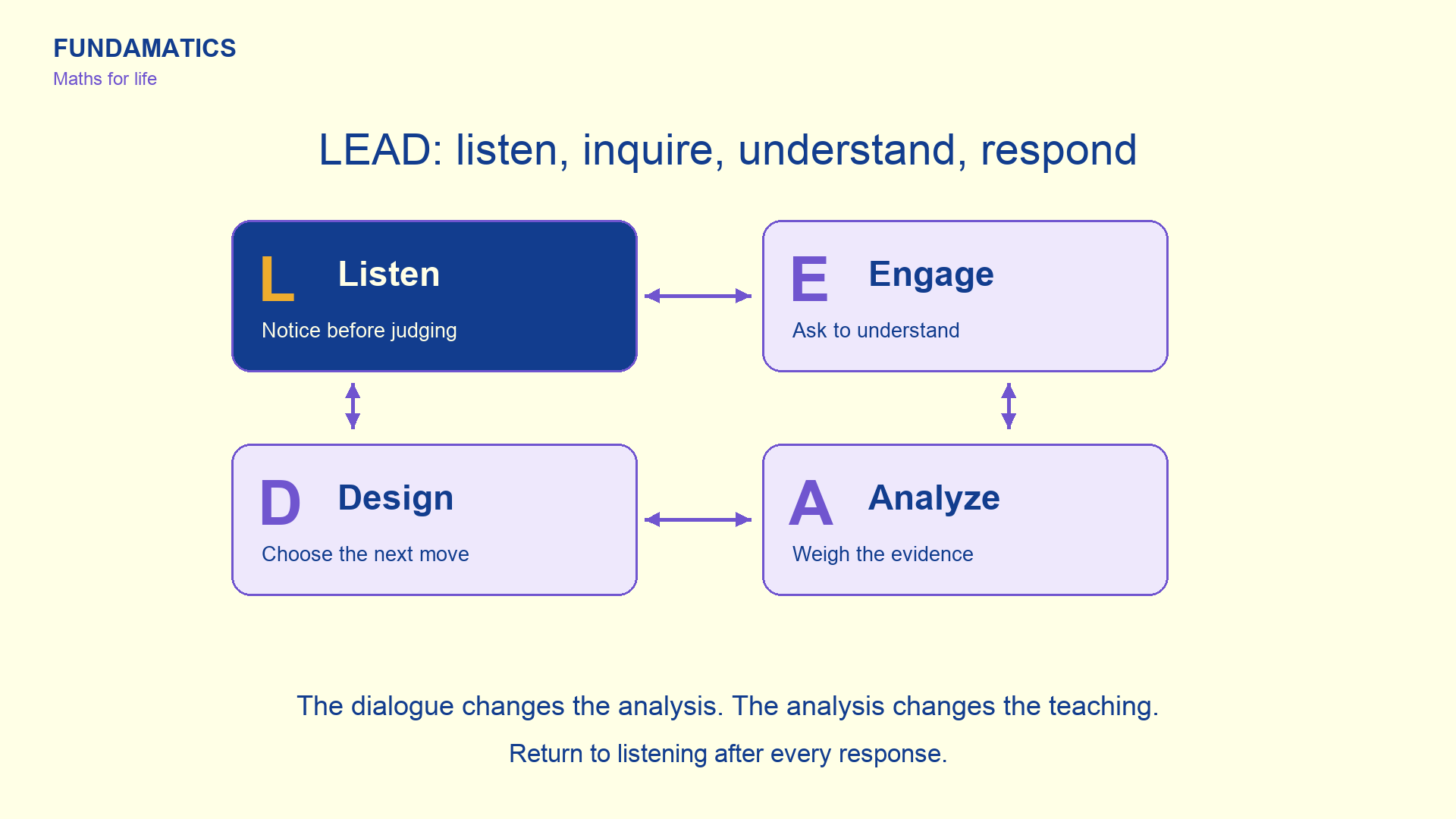
- Listen: Attend to what the learner says, shows or does, while suspending immediate judgment.
- Engage: Ask questions and invite explanation to clarify what you do not yet know.
- Analyze: Distinguish observations from interpretations and consider alternative explanations.
- Design: Choose the next question, task, experience or pedagogical response.
The actions inform one another. Dialogue can change the analysis; the analysis can change the teaching. After a response, return to listening to what happens next.
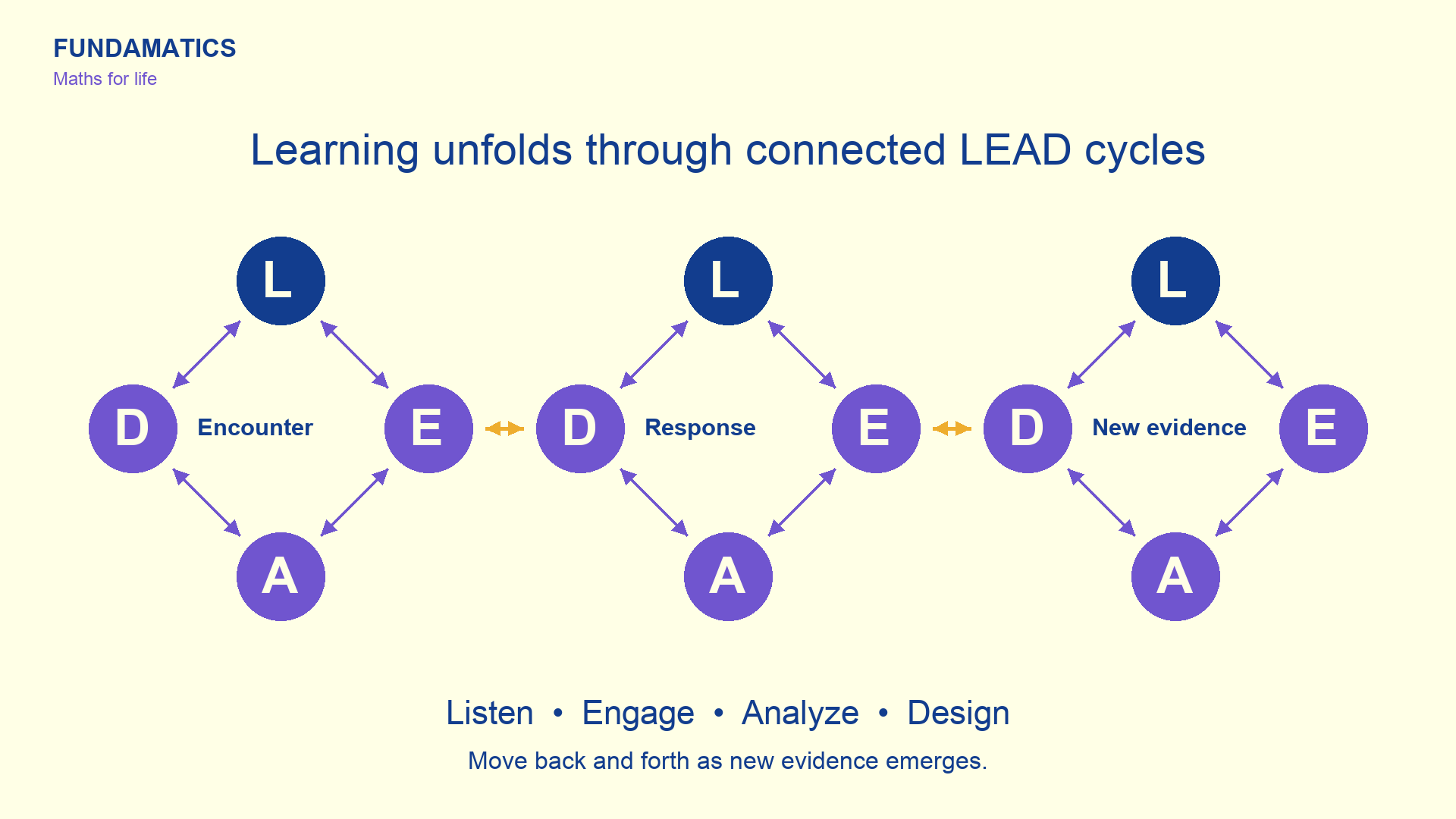
Give the learner room to think
I also share my own difficulty: watching a learner take a route that may lead to a dead end, and resisting the urge to interrupt immediately.
Allowing room for the learner to try, explain and reveal their way of thinking can give the teacher information that changes the next move.
Three questions for your next lesson
- What is the student actually saying, showing or doing?
- What is already clear to the student, and what am I only assuming is clear?
- What could I ask before I offer another explanation?
When has listening to a student changed your explanation or your next question? Share your experience in the video comments.
Teaching story and voice: Gil Sher. Comic illustrations were created with AI assistance. The story is shared from personal teaching experience.